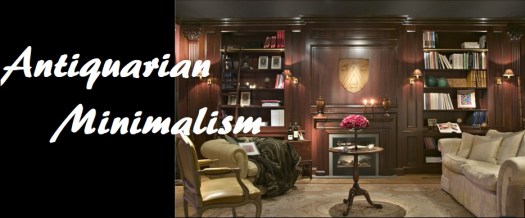
Antiquarian Minimalism


rustic

Love going to your local IKEA store? Well guess what, in interiors and architecture, Minimalism did grow to be one of the most influential styles to dominate the 21st century,  but only up until a few years ago! According to Ada Ivanoff minimalism had started taking a new form at the time (2000’s), frequently referred to as ‘Neo-minimalism’/’Neo-Geometric’/’Neo-Geo’. Despite being based on simplicity/restraint, unlike the traditional De Stijl (stark) minimalism this design culture/ideal evolved to include a variety of shapes/curves – much beyond the squares, rectangles, horizontal/vertical lines and colours – not just the primary ones. Even brands such as IKEA have started embracing a philosophy incorporating sensual and visually rich designs instead of a mere focus on practicality/form; embracing floral patterns and colours; promoting ‘home’ as a place of personal sanctuary uniquely reflecting the inhabitants’ personalities. Continue reading “Antiquarian Minimalism”


Note to Self….

final

Delving into the various different cultural contexts of interior design aesthetics across the world has veritably been my favourite pastime! Whether it’s Oriental interiors, English or Asian aesthetics, when appraised within the respective anthropological perspective each emerges as breathtakingly stunning in its own right.

I had the privilege to study the Japanese aesthetics and philosophy for an interior design project just recently and gained so much more than just knowledge of the academic/design principles. Continue reading “Note to Self….”

Design For the Expression

picture

The Index Trade exhibition this year (March) was profoundly propitious and as enlightening for the industry people, whether amateurs or experts, as it has been in the previous years. Launched in 1990, each year INDEX brings together Middle East and North Africa’s largest gathering for the design community. Showcasing a plethora of prowess and exhibits – from all over the world, useful for industry people of the likes of architects, interior designers, developers, procurement professionals and even students (for networking as well as sourcing), it sets the design tone for all to look up to.

Continue reading “Design For the Expression”